Why good crews still stand around
Most lost time at a concert load-in is not caused by incompetent vendors. A staging company, an audio provider, a lighting rental house and a video contractor can each arrive with a solid internal plan. The problem is that four solid plans are not one schedule. When a concert load in schedule leaves vendors to work out the order among themselves on site, the result is predictable: several trucks at one dock, crews waiting for floor space, and arguments about who goes first.
This guide treats load-in as a coordination problem for the person buying or overseeing production. It is not a rigging method statement and does not explain how to build structures, hang loads or connect power. Those tasks belong to qualified professionals working under their own procedures, the venue's rules and whatever local requirements apply.
Build one site-specific sequence
Production load in coordination starts with a single written sequence for this venue on this date, not a template copied from the last show. It should run in order through site access, stage erection, approved rigging work, power readiness, department setup for audio, lighting and video, and finally line check and rehearsal. Each step needs a start window, a responsible company and a clear statement of what must be true before the next step begins.
OSHA's page on communication and coordination for host employers and contractors describes recommended practices for sharing hazard information, coordinating work and identifying responsible parties before contractors arrive [S1]. That is federal guidance framed as recommended practice, not a substitute for venue rules, local permits or each contractor's own legal duties, so confirm specific requirements with the venue and the local authority having jurisdiction.
- Write the sequence for the actual site, including load paths and floor conditions.
- Circulate it to every vendor before trucks are dispatched, not on arrival.
- Ask each vendor to confirm in writing that its crew size and timing fit the sequence.
Give one person real authority
A schedule without an owner turns into a negotiation. Assign a production manager who holds every vendor's site lead contact, knows each contract's scope, and has explicit authority to resolve timing conflicts. That authority should be stated in writing before show day so crew chiefs know whose call is final when two departments want the same space or the same hour.
Authority to sequence work is different from authority over safety. The production manager decides order and access; qualified riggers, structural professionals, licensed electricians and venue safety staff decide whether their specialized work is ready and safe. The OSHA material emphasizes identifying responsible parties in advance [S1], and a good contact sheet makes that concrete: name, company, role, phone and what decisions each person can make.
Truck slots, unloading and emergency access
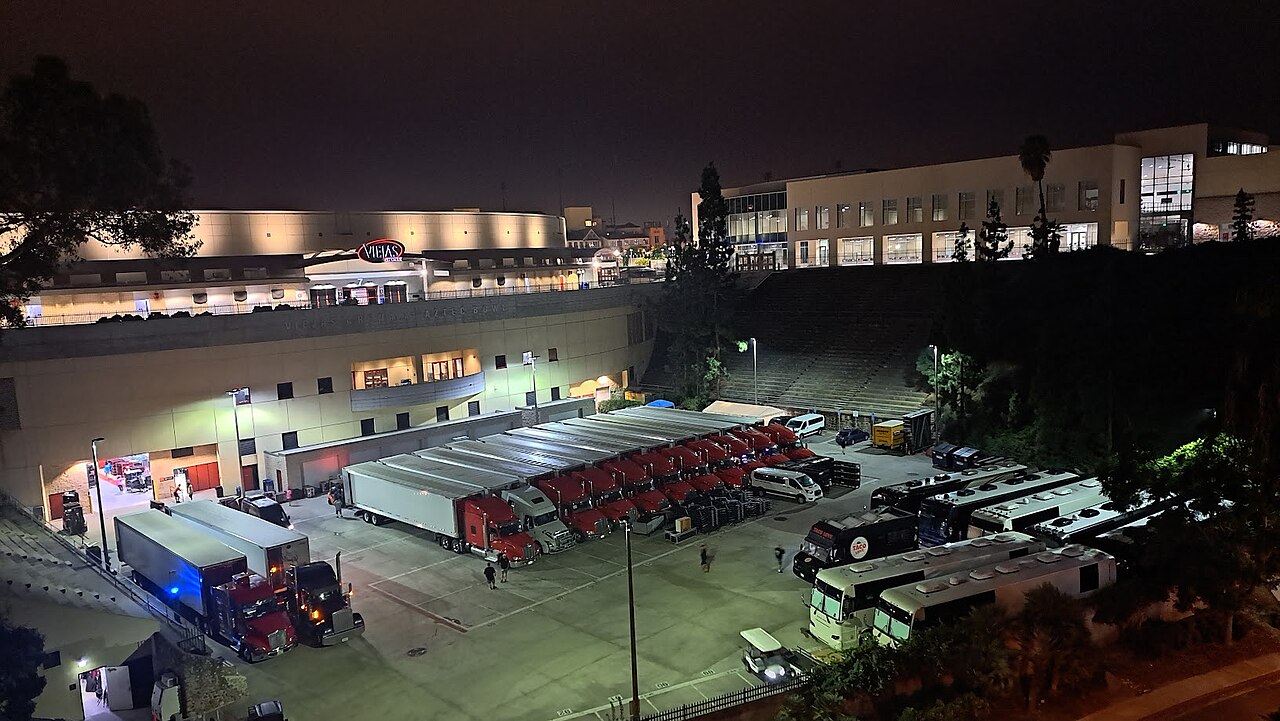
A concert truck unloading schedule prevents the most visible waste. Give each truck an arrival slot, a specific unloading location, and a destination for empty cases. Staging steel usually needs to come off first because everything else depends on it, while video and backline can often arrive later. Staggering arrivals keeps drivers from idling and keeps the dock clear for the trade that actually needs it.
Case storage is often forgotten until the floor is full. Decide in advance where empties go, who moves them, and when they return for load-out. Most importantly, mark emergency access routes, fire lanes and exits that must stay unobstructed at all times, and confirm those routes with the venue. Tailgate lifts, forklifts and lifts should be operated only by trained, authorized people; do not plan around volunteers or untrained helpers running them.
- Arrival slot and contact for each truck
- Assigned dock or unloading zone
- Case storage location and return time
- Emergency routes that must never be blocked
Dependencies that cannot be improvised
Some stage sound lighting dependencies are flexible; others are fixed. Audio and lighting can sometimes trade floor time. A video wall that must hang from a stage roof or shared structure is a different matter, because its weight, wind exposure and attachment points affect whether that structure is suitable at all. Those requirements must reach the staging provider and any responsible engineer before the roof or structure is finalized, not after it arrives.
In one Reddit thread, presented here as a community anecdote rather than authority, people discussing an outdoor LED wall disagreed about roof capacity, which lifts to use and when each vendor should work [R2]. The excerpt also reflects a point worth repeating: opinions based on photos cannot verify structural safety [R2]. Buyers should ask the staging and video vendors for written confirmation that the specific load has been reviewed by whoever is qualified to approve it.
The site briefing and what helpers must not do
Before work starts, hold a short briefing with every crew lead. Cover work zones, who supervises each zone, how crews communicate, overhead work exclusion areas, and which tasks inexperienced helpers must not undertake. This reflects the OSHA recommended practice of sharing hazards and coordinating work across employers [S1]. Keep it short enough that people actually attend, and record who was present.
A Reddit post illustrates why this matters. As an individual anecdote, a first-time production worker described receiving little detail about tasks on a job involving stage construction and flown speaker arrays, and replies warned against doing rigging work without supervision [R1]. Treat that as a reminder, not data on how common the problem is: new hands should be told plainly that rigging, lift operation, tailgates and electrical distribution are off-limits unless they are trained and authorized.
- Work zones and exclusion areas under overhead work
- Named supervisor for each zone
- Radio channels or phone tree
- Tasks restricted to trained, authorized personnel
Avoidable waiting versus a necessary safety hold
Not all waiting is waste. If a rigger stops work because attachment points are not as specified, or an electrician will not energize distribution until checks are complete, that is a necessary safety hold, and nobody should pressure them to skip it. Avoidable waiting is different: a truck that arrived early with nowhere to unload, a crew with no access badge, or a department that needed information it never received.
Record every hold with the time, duration, cause and who was affected. Then resolve the commercial consequences afterward through the contract change process rather than arguing about overtime on the dock. Separating the safety decision from the money conversation protects both: crews do not feel pushed to rush, and buyers get a fair record of whose planning caused the delay.
Sample milestone table
The table below is a format to adapt, not a standard schedule. Times and contingencies are placeholders; real values must come from your vendors and venue. Each row names a responsible party, a predecessor, the evidence that shows the next trade can start, and a contingency allowance.
Ready-for-next-trade evidence should be something visible: a signed handover, a written confirmation or a supervisor's verbal release logged by the production manager. Avoid vague markers like stage is mostly done.
- Site access open | Venue | Predecessor: none | Evidence: dock and routes confirmed clear | Contingency: 30 min
- Stage erected | Staging vendor | Predecessor: access | Evidence: staging lead's written handover | Contingency: 60 min
- Approved rigging complete | Rigging lead | Predecessor: stage handover | Evidence: rigging lead release | Contingency: 60 min
- Power ready | Qualified electrician or venue | Predecessor: distribution placed | Evidence: electrician confirms available | Contingency: 45 min
- Audio, lighting, video setup | Each department | Predecessor: rigging and power | Evidence: department heads report ready | Contingency: 60 min
- Line check and rehearsal | Production manager | Predecessor: all departments | Evidence: stage manager calls start | Contingency: 30 min
Hypothetical worked example
Hypothetical example: a 3,000-capacity outdoor show books a staging company, an audio provider, a lighting vendor and an LED wall vendor. Initially all four trucks are told to arrive at 8 a.m. The production manager instead staggers them: staging at 7, lighting and audio at 10, video at noon. While collecting dependencies, she learns the video wall would hang from the stage roof, so she sends its weight and attachment needs to the staging vendor two weeks ahead.
On show day, the staging lead holds rigging for 40 minutes because one attachment point needs checking. The production manager logs it as a safety hold, moves audio into ground-stacked prep, and nobody stands idle. Later, a lighting truck arrives an hour early and waits; that is logged as avoidable waiting caused by the vendor's dispatch. Both entries go into the post-show change discussion.
Red flags, verification and when to escalate
Watch for vendors who say the structure will be fine without written confirmation, contractors who cannot name who approved a rigging load, schedules with every truck at the same hour, and staffing offers that list unpaid helpers for rigging or power. Also be wary of overtime claims with no logged cause. Verify by asking for written load approvals, insurance certificates, the names of qualified supervisors, and the venue's rules for docks and power.
Escalate when a dependency is unresolved within days of the show, when two vendors give conflicting answers about structural capacity, when anyone pressures crew to skip a safety hold, or when a dispute grows beyond a simple change order. Escalation may mean involving the venue's production or safety staff, an independent qualified engineer, the local authority having jurisdiction, or your own legal adviser for contract questions.
Your next steps
- Write one site-specific load-in sequence and send it to every vendor before dispatch.
- Name a production manager in writing with authority to resolve timing conflicts.
- Assign truck arrival slots, unloading zones and case storage locations.
- Mark emergency routes that must stay clear and confirm them with the venue.
- Send video, lighting and audio loads to the staging vendor before the roof or structure is finalized.
- Hold a short site briefing covering zones, supervision, communications and restricted tasks.
- Log every hold with time, cause and affected crews, separating safety holds from avoidable waiting.
- Settle cost impacts through the contract change process after the show.
Questions that come up next
Who should own the load-in schedule?
One production manager should own the combined sequence and hold every vendor contact, with written authority to settle timing conflicts. That role decides order and access, while qualified riggers, electricians and venue safety staff keep authority over whether their specialized work is safe and ready. Confirm both roles in writing before show day.
Is OSHA coordination guidance a legal requirement for concerts?
The OSHA page cited here describes recommended practices for communication and coordination among host employers and contractors. Treat it as federal guidance, not a complete statement of your obligations. Specific duties depend on the employers involved, venue rules and local requirements, so verify with the venue, the local authority having jurisdiction and your own legal adviser.
Can volunteers help with rigging or truck tailgates?
Plan as if they cannot. Rigging, lift operation, tailgates and electrical distribution should be handled only by trained, authorized personnel under qualified supervision. Untrained helpers can sometimes carry approved items in designated zones, but the briefing should state clearly what they must not touch. Check the venue's and each vendor's own rules.
Sources & further reading
Community discussions identify lived problems; they do not establish technical or legal requirements. Primary references support the specific claims cited above.
- R1 / COMMUNITY DISCUSSIONLoad in and out for production company ↗
- R2 / COMMUNITY DISCUSSIONQuestion about led wall rigging ↗
- S1 / PRIMARY REFERENCEOSHA: Communication and Coordination for Host Employers, Contractors, and Staffing Agencies ↗