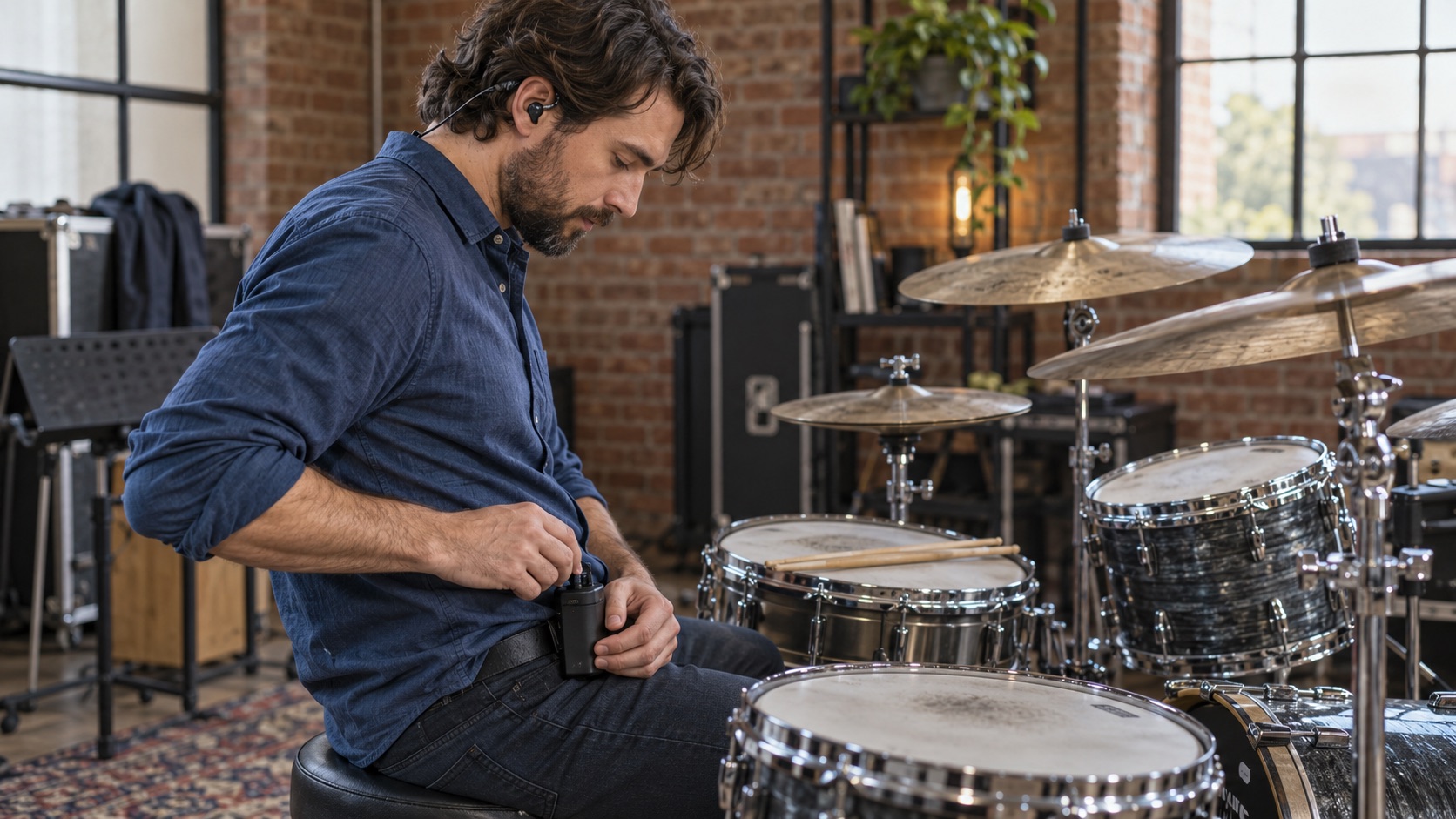
The problem: one knob, two jobs, and no free hand
Many bodypacks combine power and volume on one knob. You find a good level at soundcheck, switch the pack off to save the battery or stop the noise, and then have to find that level again under stage pressure. In one Reddit thread, a guitarist described this situation: the knob also powers the pack off, and the opening song leaves no chance to reach for it [R1]. That is a single anecdote and says nothing about how common the problem is, though many players will recognize it.
There are two risks. If the level comes back too low, you play the first song half-blind and may overplay. If it comes back too high, the first downbeat or cymbal hit lands hard in a sealed ear canal. The routine below makes both outcomes less likely. It cannot promise any particular sound level at your eardrum.
Why a knob mark is a repeatability aid, not a safety calibration
Marking the soundcheck position with tape or a paint pen is a sensible habit. It returns the knob to roughly the same physical spot. It cannot tell you what you will hear, because the level reaching your ear also depends on the mixer signal, the transmitter output, the earpieces and how well the tips seal that night. If the engineer changes your mix gain or a tip sits slightly looser, the same mark can sound quite different.
Treat the mark as a starting reference, never as proof of a safe level. NIOSH, a US federal agency, recommends exposure assessment, lower rehearsal levels, hearing protection and hearing evaluations for musicians [S1]. A strip of tape replaces none of those. It helps you repeat a setting; whether that setting suits your ears is a separate question.
Check seal and mix before adding volume
Before touching the volume, confirm the earpieces are fully seated. A poor seal lets stage noise in and often thins the low end, so the natural reaction is to turn up. When the tip later settles, the level jumps. Reseat each earpiece and listen for the change in isolation before the pack comes up.
Then confirm the mix itself is usable. If you can't hear your own instrument, more overall volume usually makes everything louder without solving anything. Ask for the specific source you are missing, or for competing sources to come down. A monitor mix that feels too loud is often an unbalanced mix rather than a pack turned up too far.
Agree on a controlled pre-show cue with the engineer
The safest moment to restore level is before the band plays, using a sound you can predict. Agree with the monitor or front-of-house engineer on a short cue during line check or just before walk-on: steady talkback, a quiet loop of your instrument, or soft playback through your mix at a moderate level.
Make the arrangement mutual. The engineer should know you will bring your pack up during that cue and avoid sudden changes at the same moment. You, in turn, confirm when you are set with a hand signal or a word agreed in advance.
Verify pack, mixer and limiter behavior in the actual manual
Bodypacks, transmitters and mixers differ. Some packs may offer a limiter, a volume cap or a separate power switch; others may not. Don't assume your unit behaves like a bandmate's or like a forum description. Get the manual for your exact model and firmware and check which features exist and how they are adjusted.
Be realistic about limiters. They restrain peaks above a threshold, but no single threshold or knob position guarantees safe exposure at your eardrum, because seal, earpieces and listening time all matter. If the manual leaves you unsure how the limiter interacts with the volume control, ask the manufacturer's support team rather than guessing.
- Confirm whether power and volume share one control on your model.
- Find out whether a limiter exists, where it sits in the signal chain, and how it is set.
- Ask the engineer whether any limiting or compression is applied to your mix at the console.
A low-level power-on and gradual check routine
Order matters. Insert and seat the earpieces first, then switch the pack on at the lowest point the knob allows. Wait for the agreed cue before raising the level. Turn up slowly, pausing between moves so your ears can judge each step, and stop at the first point where the cue sounds clear, even if that is below your mark.
If the cue is clear well below the mark, the upstream level or the seal has probably changed, so don't push up to the mark just because it is there. Choosing the lowest level that works fits the general direction of the NIOSH recommendations on lower levels [S1], though that bulletin does not describe an IEM-specific routine.
- Earpieces in and sealed before power-on.
- Pack on at minimum.
- Raise gradually only during the agreed cue.
- Stop at clarity, not at the mark.
Plan an intro or count-in that allows a final adjustment
If your opening song starts with both hands busy, build in a short window. A spoken welcome, a drummer's count-in, an ambient pad or a few bars led by another player can each give you a moment to hear the full band and nudge the pack once.
Decide this at rehearsal, not on stage. If the setlist can't change, ask whether the engineer can hold your mix slightly lower for the first song and bring it up when you signal. That depends on their workflow, so agree on it explicitly.
Keep pack settings and upstream changes in the show notes
A knob mark only means something if the rest of the chain stays the same. Record your pack position, any limiter setting, the earpieces and tip size you used, and whatever transmitter or console settings the engineer is willing to share. When anything upstream changes, note it with the date and venue.
Over several shows these notes reveal patterns, such as sitting lower in small rooms or a new mix template shifting your reference. That record beats memory and gives a new engineer a useful starting point.
Hypothetical worked example
Hypothetical: a guitarist marks the pack at roughly two o'clock during soundcheck, then switches it off during changeover. Before walk-on, they reseat both earpieces, power on at minimum and wait for the engineer's talkback cue. The voice is clear at about noon, well below the mark, so they stop there and signal the engineer.
The drummer's count-in gives one last check against the full band, and they nudge slightly upward. Their notes afterward read: clear at noon tonight; engineer raised my mix gain after soundcheck. Next time, they ask about gain changes before relying on the mark.
Red flags, misleading claims and when to escalate
Be skeptical of any product listing, accessory or advice claiming a knob position, preset or limiter setting is hearing-safe for everyone. Be equally wary of phone apps sold as accurate in-ear level meters unless they explain how measurement inside a sealed ear canal is calibrated. Check claims against the manufacturer's documentation for your model; if it doesn't support them, treat them as marketing.
Escalate when the routine isn't enough. Contact manufacturer support if the pack behaves inconsistently or the manual is unclear, and talk to the engineer or production manager if your mix keeps changing without notice. For ongoing ringing, muffling or discomfort after shows, book an audiology appointment; hearing evaluations are part of the NIOSH guidance for musicians [S1]. Sudden hearing loss is different: NIDCD patient guidance treats sudden deafness as a medical emergency, advises seeing a doctor immediately, and notes that delaying diagnosis and treatment can make treatment less effective [S2]. Don't wait for a routine slot.
Your next steps
- Mark your soundcheck knob position as a reference only, not a safety guarantee.
- Reseat earpieces for a full seal before powering the pack on.
- Fix mix balance problems before raising overall volume.
- Agree on a specific pre-show cue and a ready signal with the engineer.
- Read your exact model's manual for power, volume and limiter behavior.
- Power on at minimum and raise the level gradually only during the cue.
- Build an intro or count-in that allows one final adjustment.
- Log pack settings and any upstream mix changes after each show.
- See a doctor immediately for sudden hearing loss; book routine hearing evaluations for ongoing exposure.
Questions that come up next
Can I just set the knob to my tape mark and play?
You can use the mark as a starting point, but don't rely on it alone. Upstream gain, earpiece seal and venue changes can all make the same knob position sound different. Bring the level up during a controlled cue and stop where the mix is clear, even if that turns out to be below the mark.
Does a bodypack limiter make my monitors safe?
No limiter setting guarantees safe exposure at your eardrum. Seal, earpieces, mix content and listening time all affect what you actually hear. Check your model's manual to see whether a limiter exists and how it works, and ask the manufacturer about anything unclear. Treat a limiter as one protective layer, not a substitute for sensible levels.
What should I do if my ears ring after a gig?
Take it seriously and review your levels. NIOSH guidance for musicians includes hearing evaluations [S1], so book an audiology check and bring your show notes. If your hearing drops suddenly, NIDCD guidance describes sudden deafness as a medical emergency and advises seeing a doctor immediately, because delay can reduce treatment effectiveness [S2].
Sources & further reading
Community discussions identify lived problems; they do not establish technical or legal requirements. Primary references support the specific claims cited above.
- R1 / COMMUNITY DISCUSSIONHow to Set IEM Volume Before Performing ↗
- S1 / PRIMARY REFERENCENIOSH: Reducing hearing risk among musicians ↗
- S2 / PRIMARY REFERENCENIDCD: Sudden Deafness ↗